

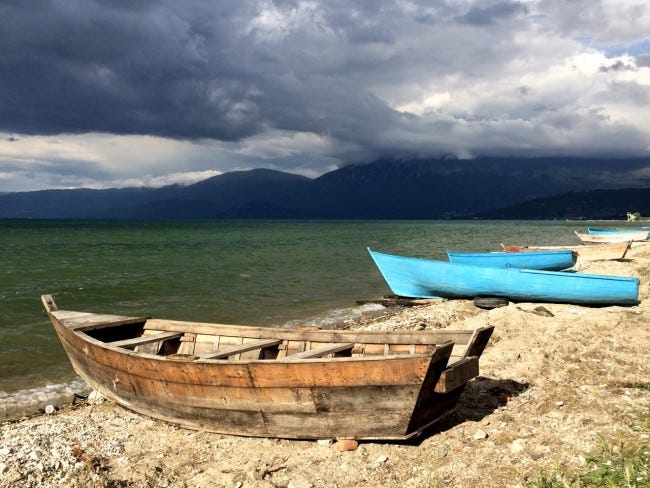
It’s a bit absurd, but there are no transport connections between Pogradec and Ohrid or Struga. Pogradec lies on the southern shore of Lake Ohrid in Albania; Struga is on the northern shore, and Ohrid—the famous Ohrid—is on the eastern shore in Macedonia. At night, you can see the lights shimmering and blinking from Pogradec, coming from the other side, from Macedonia, but you simply cannot get there. At least not by bus, and certainly not by a direct route.
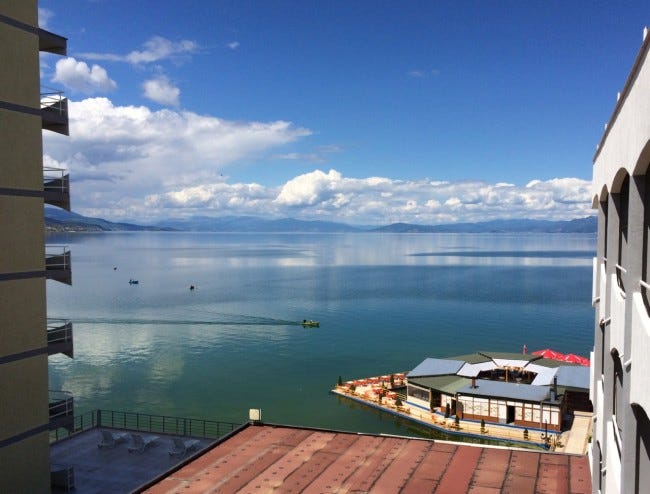
Lake Ohrid is considered one of the oldest in the world, formed millions of years ago by a tectonic rift. It has no major inflows and is fed primarily by underground springs—you might think of it as a classic mountain lake, were it not so gargantuan. The lake is split equally between Macedonia and Albania, surrounded by mountain massifs, and with its usually shimmering, smooth, and unruffled surface, it feels somewhat forgotten by the world.
Pogradec is certainly that; only three floors of one wing of the immense Enkelana hotel complex are actually open. One is occupied by a fabulously chatty, elderly troop of German bikers—”Germany” is emblazoned in blue Fraktur script across the top back of their leather vests. If you stripped them of their uniforms, they wouldn’t look out of place at a party resort in Mallorca. The second floor is reserved for Albanian families and commercial travelers, while on the third, I reside entirely alone.
I should mention that in this entire region, you don’t pay for the room, but per person. This makes hotels very affordable for me, and I like hotels because they are spaces of retreat. I can move between the terrace and my room and back again in total peace, go shopping in between, and no one asks questions, no one wants anything, nothing happens—and I am the sole master of my daily routine.
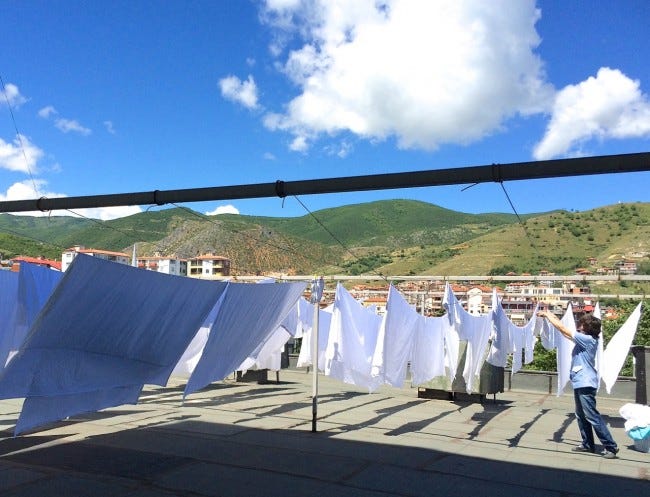
In august, however, Pogradec is one of the favorite destinations for Albanians due to its pleasant climate; the town is packed then, the Enkelana fully booked, and there’s hardly any room on the promenade in the evenings. During that season, a boat also runs to Ohrid twice a day, and the holy city of Ohrid diagonally opposite—the city of 365 Orthodox churches—is well-visited, its rooms and little pensions booked solid.
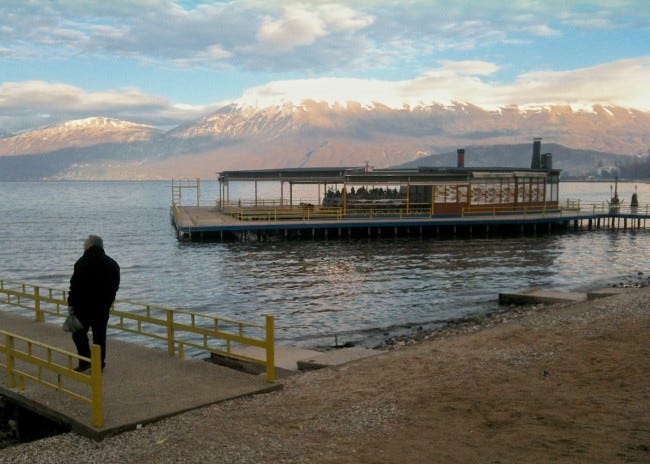
But it’s not that time yet. Years ago, in the middle of winter, I visited Ohrid once before and traveled from there via Sveti Naum to Pogradec. The mountain peaks were covered in deep snow, the air was cold and damp, and Pogradec had appeared gray to me—cold and lifeless, the entire area somewhat inhospitable.
That is completely different now. The vegetation is lush, the sun has awakened the colors, and the air possesses a gentle freshness—that calm liveliness found only by lakes. Even the mountains seem less rugged to me, appearing rounder and softer; but that is an illusion, born from the fact that Pogradec already sits 600 meters above sea level, bringing the 2,000-meter peaks much closer.
Out of the corner of my eye, I saw my driver slip a banknote into his vehicle registration papers; it must have been a Macedonian 100-denar bill. After that, everything moved very quickly with the paperwork. Unlike the Albanian customs earlier, the Macedonian officials showed no interest in my luggage.
I had taken a furgon from Pogradec up to the ridge. There, after several switchbacks, a turn-off leads along the crest directly to the small border station. On the other side, the road descends into the Black Drin valley and back toward Struga on Lake Ohrid. Originally, I had planned to walk the short distance to the border, assuming I’d find something on the other side. However, a few Mercedes-Benzes were stationed at the junction, and one of the drivers offered to take me all the way to Struga for ten euros. Fair enough—done and dusted.
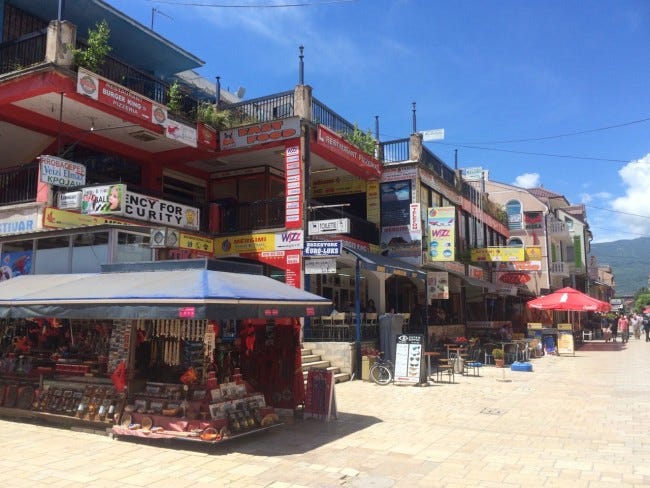
And so it happens that I arrive in Struga before noon, searching for the supposedly picturesque old town. It doesn’t exist—or doesn’t exist anymore, who knows. There are all sorts of signs, more signs and inscriptions, travel agencies, restaurants, and significantly more “Rooms for Rent” than in Pogradec. It looks as though all hell breaks loose here in the summer, though I find that hard to believe.
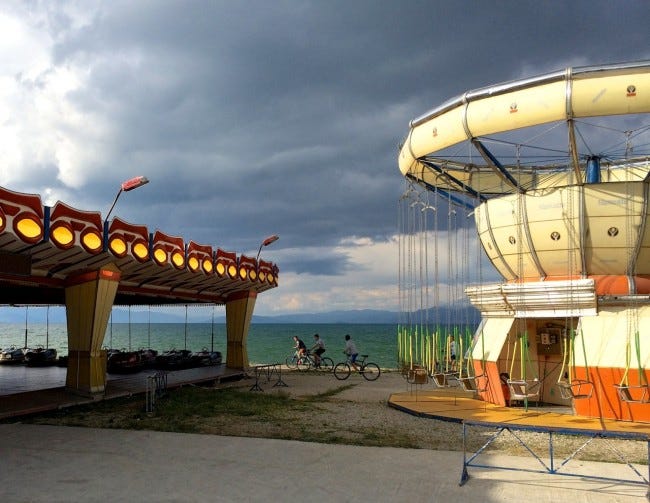
This slightly skewed, comparatively extroverted appearance is really the only difference. In Struga, too, a minaret stands right next to an Orthodox church; in Struga, too, Albanian is spoken. In Struga, a stout, black-clad Orthodox priest stares at his phone for minutes on end, while various buzz-cut men—no longer quite young—sit in the cafés discussing non-existent opportunities. Dutch tourists stroll up and down the somewhat dreary promenade along the lakeshore, eventually renting dilapidated paddle boats or eating shishkepab or qofte with patate and domate written in Cyrillic.
Every taxi driver who spots me automatically assumes I want to go to Ohrid. But I don't want to go to Ohrid; I want to follow the course of the Drin, which drains Lake Ohrid to the north and flows in a long curve via Peshkopi and Kukës down to Shkodra, toward the Adriatic. Nature does not abide by national borders—so why should I?